こんにちは、Everyone. Let’s start the section 4-4. In Japan, already like summer season. You feel so humid when you stay in urban area. Much better to stay in mountain area in summertime.
Let’s start it.
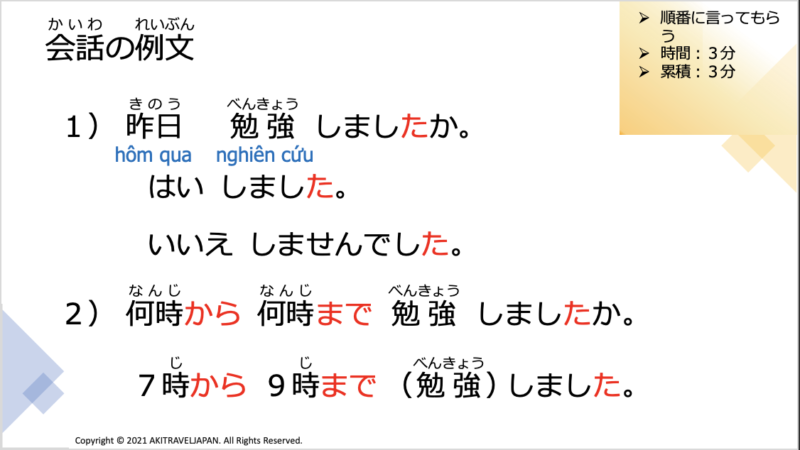
- KINOU BENKYO-SIMASITA KA? HAI SIMASITA / IIE SIMASENDESITA
- NANJI KARA NANJI MADE BENKYO-SIMASITA KA ? HITIJI KARA KUJI MADE (BENKYO-) SIMASITA.
Meaning,
1). Did you study yesterday ? Yes I did. / No,I didn’t.
2). Did you study from what time until when ? I studied from 7 to 9.
Today’s lesson is past sentence. Present and future sentence are used ” します“. But in past sentence is ” しましたか“. In English language has this rule, change y to I and add ed. Example : ” study” and” studied “. Japanese language also has this rule. KINOU meaning, yesterday. That’s why, we should use ” しました“. and put ” か“ is an interrogative sentence.
Then the answer, ” はい、しました ” ” いいえ、しませんでした “. All sentences are past sentences because of ” しました” ”しませんでした“. Don’t say answers” します” ”しません“.
If you meet the Japanese sentence, remember to check the tense. Is this past or is this present? There are only 2 tenses in Japanese sentence past and present/future. This is very important matter.
Let’s try to answer bellow exercises.
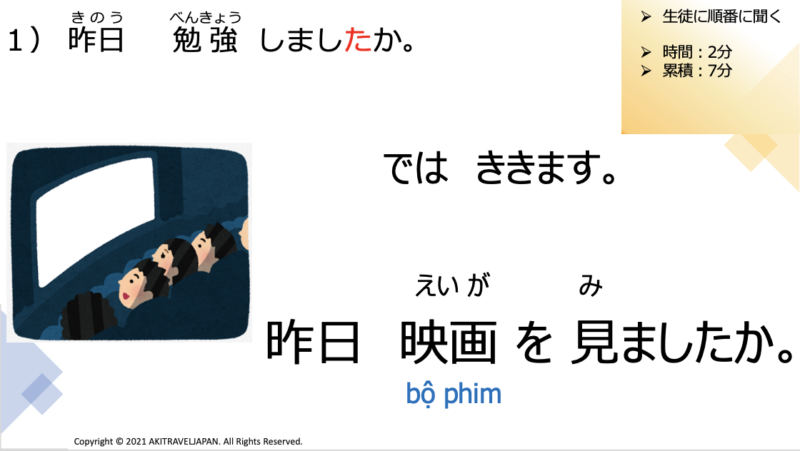
WORD : えいが EIGA movie. 見ましたか MIMASITA KA watch
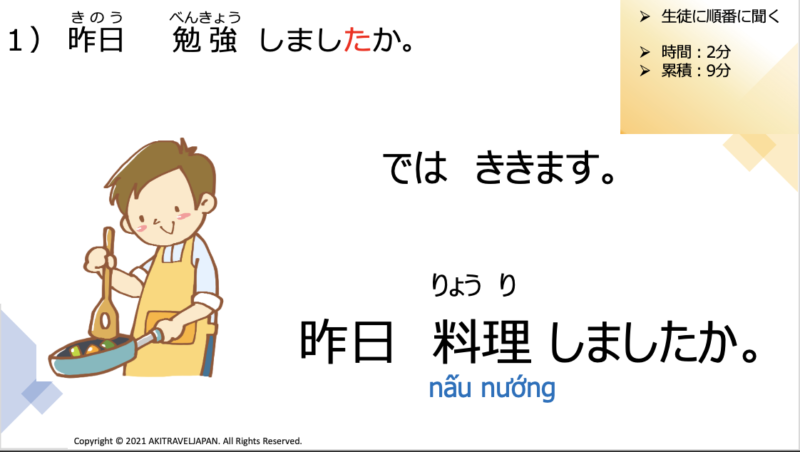
WORD : りょうり RYOURI cook
Then next sentence, 〜kara 〜made.
2). Did you study from what time to until when ? I studied from 7 to 9.
This is what we have learned previous section 4-3. I guess this meaning. Then this sentence add past sentence. ” べんきょうしましたか “. Answer is ” 〜から〜までしました “ is okay. Is it easy right?
Dividing past and present/future sentence is the most important matter for understanding its meaning. So, you must confirm” た “ word position after the verb. For example, ” いきました ” ” きました ” ” かいました ” ” あるきました “ , those words are past sentences .
we are done is with this lesson. Is it okay for checking ” た “ ?
See yah !