みなさん、こんばんは。 げんきですか。 It’s so hot every day. How is in your country? If you have plan to travel to Japan during summer season, you should bring more towels.
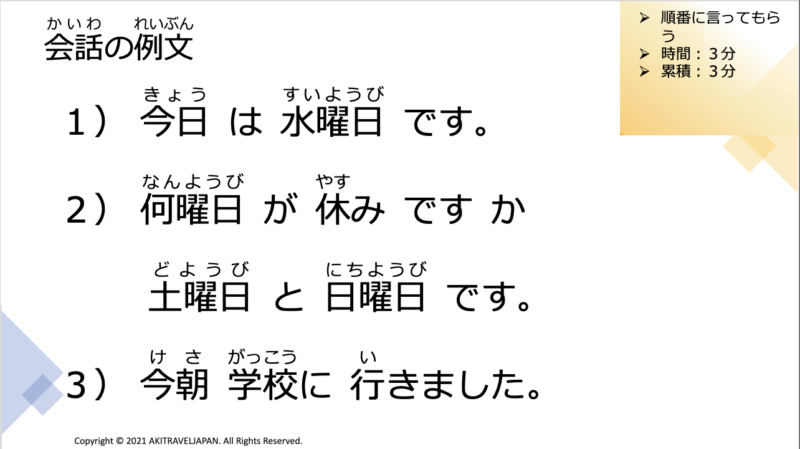
Today’s lesson. we learn some term or words.
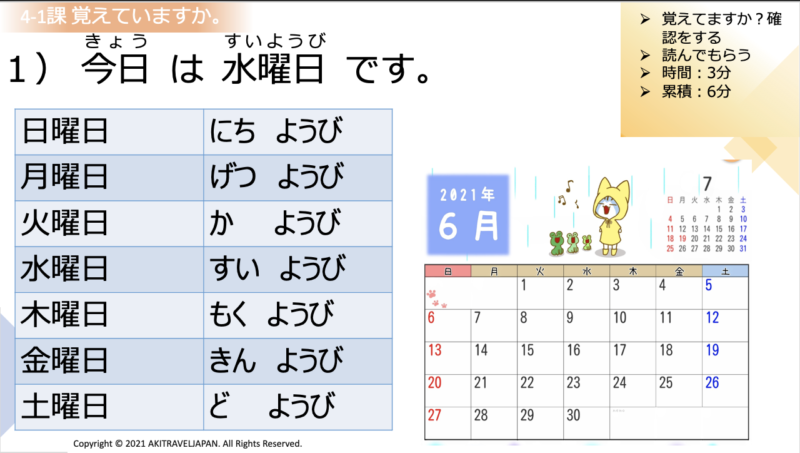
- KYOU WA SUI YOUBI DESU. Today is Wednesday.
2. NANYOUBI GA YASUMI DESUKA? What days of the week are your day off?
3. DOYOUBI TO NITIYOUBI DESU. It’s Saturday and Sunday.
4. KESA GATT KOU NI IKIMASITA I went to school this morning.
At first, the words phrase as ” day of a week ” .
Then , No.2. ” 休み ” meaning, day off. Work is ” 仕事 ” SIGOTO. This sentence is all asking you about day off. The opposite sentence is ” 何曜日 が 仕事ですか “.
Then , your answer is ” A と B ”. ” と ” is ” and “. So, you answer, Saturday and Sunday.
Is it okay? Can I proceed ? Next new word, ” けさ “. meaning, this morning. I went to 〜. ” 〜に行きました。”. This is past sentence. So,, ” 行きました “.
Actually, Japanese words, Only have 2 ways, the past and present/future. Do you still recognized ? ” 行きました ” and ” 行きます “. Key point is ” た “.
Okay. I give you sentences bellow for reading exercises.
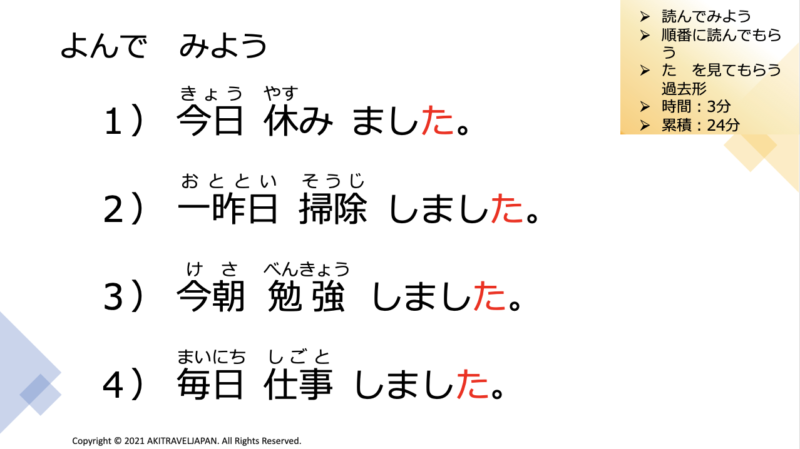
New word, ” 一昨日 ” Meaning, before yesterday. and ” 毎日 ” is every day.
- KYOU YASUMI MASITA.
2. OTOTOI SOUJI SIMASITA.
3. KESA BENKYOU SIMASITA.
4. MAINITI SIGOTO SIMASITA.
Next our assessment, we change to negative sentence. 1. KYOU YASUMI MASITA. Meaning, I took day off today. In Japanese language, ” せんでした “. This is negative word.
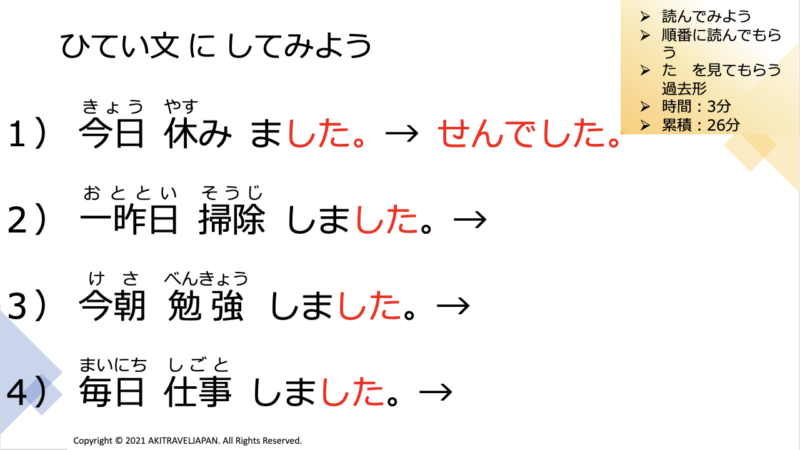
KYOU YASUMI MASEN DESITA.
OTOTOI SOUJI SIMASEN DESITA.
KESA BENKYOU SIMASEN DESITA.
MAINITI SIGOTO SIMASEN DESITA.
Okay. today’s lesson is done. we learned negative of past sentence. ” せんでした “. SENDESITA.
Hopefully, you won’t take day off with this lesson.
Thank you for joining us. See yah!